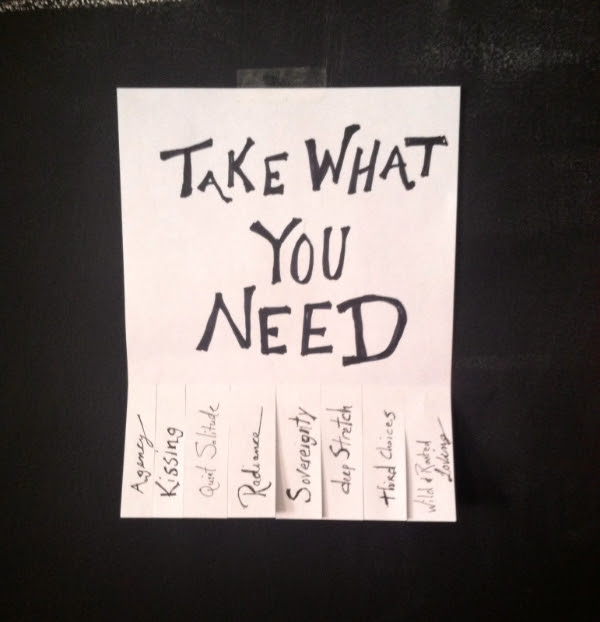
Take What You Need

Take What You eed

“What do your words, your heart and art, need?” she asked.

When you ask questions for a living as I do, it’s easy to forget to ask yourself and like the cobbler’s children I sometimes go without.

In taking care of others, we ignore or suppress what we ourselves need so very much.

What do you need? 

For me, there are essential ingredients to this recipe of need. They are simple, and yet often just beyond my reach in the busyness of life.

time

silence

depth

touch

laughter

Because I need them, I expect them to be there naturally, auto-magically. Sadly, it doesn’t work that way.

My need calls for devotion, but that’s only part of it for as Isabel Abbott reminds me,

Devotion is not the answer, or any answer. It is orientation, a way of being in the world, of giving ourselves over to belonging to life, and letting life love us. It is a way of being here.

Here, where we might take our legion hearts and choose this life, again and again and again.

Again and again and again.

Ahh, sweet life, you bring me back to choice once more.

Taking care of our needs is a choice, but it’s not a one-time thing.

[Tweet “The best things in life need our time and attention.”]

It’s the daily act of checking in with heart and soul, while giving the head a break.

Because it’s easy to ask what the head needs, and it’s quick to give a reply, an opinion, a judgment, usually focused on some aspect of survival.

Which is good except for this one important truth…

Your survival is rarely at stake.

Even during the most challenging, wrenching times of your life, your survival was rarely an issue.

Telling the truth about that will lead you back to your heart where your deepest needs are waiting.

“What do your words, your heart and art, need?” she asked.

My words need time and space.

My heart needs love, always love.

My art needs to remember.

Telling the truth changes everything.


*Inspired by Isabel Abbott’s: heat – 27 days of creative burn


The Humanity of Needs

Mural & graffiti wall Portland Oregon

According to Anthony Robbins, human beings have six basic human needs:

Certainty – to be comfortable and avoid pain

Variety – to have stimulus, change and surprise in your life

Significance – to feel special and worthy of attention

Connection & Love – to feel connected and loving, of yourself and others

Growth – to feel fully alive and continually growing

Contribution – to contribute beyond yourself, creating meaning and serving the greater good

We all have these same needs, we just get them met in different ways, both positive and negative.

For example:

You can meet your need for certainty by deciding to believe in yourself OR deciding to never leave your house again. Yes, both those decisions meet the need.

This happens all the time and explains why we so often begin things only to sabotage and lead ourselves to failure. I think that’s also when your lizard brain makes itself known!

Anything you find difficult but love to do, you can bet it’s because some of these needs are being met.

And when you have a sense that taking an action will meet many of your needs, you’re more likely to follow through.

On the flip side, if there’s something you put off, ignore or avoid doing, it’s because how you currently think of it causes a feeling of lack, that it won’t fulfill any of your needs.

Here’s the interesting thing about these needs –

Anything you do can meet ALL of these needs if you change your perception (what you notice and/or believe) or your strategy (how you get it done). More on that in a future post.

It all starts with awareness.

You’ve got to become aware of not just what you’re doing, but why you’re doing it. This awareness can then lead to a new strategy to fulfill on what you want in life.

What if for one week you simply noticed how your needs show up?

Nothing to do, nothing to fix.

Just notice.


Over to you:

  • Which of the six needs do you focus on most?
  • What do you do to meet that need?
  • What do you make it mean that you focus on that need?
  • And what if it didn’t mean that at all?