When I started blogging I declared somewhat boldly that I had come up with a theme, a road map of where I was headed. It was all well and good to begin just to begin (thanks to guru Seth and his call to action), but I’d begun questioning my Why.
Why do it? Why put myself out there? Why take the risk?
As the doubts began to creep in, I decided to return to my tribe – who I love and trust much more than my lizard brain – and what they told me was this:
I’m relentlessly curious, a life-long learner and I’ve got more questions up my sleeve than Houdini!
It’s so damn easy to forget who I really am when LB starts whispering in my ear.
It blows my mind that somehow I stumbled upon the profession of coaching and had the biggest insight of my life: this is what I’m supposed to be when I grow up!
What a relief to finally know and begin using my strengths rather than wondering why I had them! Up until then no J.O.B. had fit the bill and I constantly felt like a round peg in a square hole.
It’s been said when you know your Why, anything is possible.
My Why was so big (honouring my values of growth, learning and contribution) and so loud that it drowned out my lizard brain long enough that I could take the first steps, and then the next.
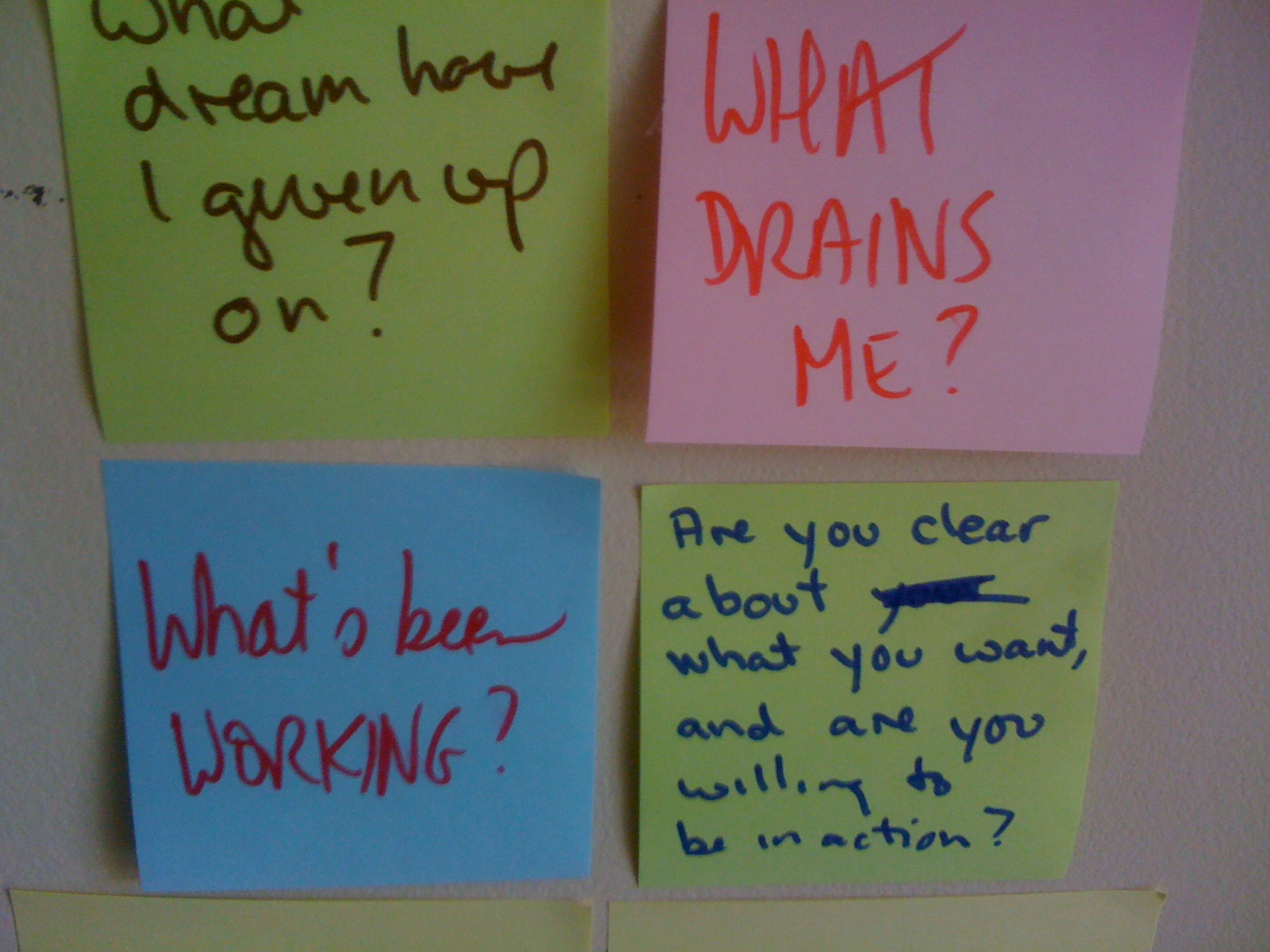
It took something to keep my word, writing and posting – shipping – every week. I began by really getting into the questions. I jotted down questions that worked with clients; questions I overheard; questions we usually don’t have the courage to ask ourselves.
Then I read How to Think Like Leonardo da Vinci. In this very cool, yet practical guide Michael Gelb invites us to begin training our vast untapped resources to start thinking like Leonardo.
Is it really possible to think like a Renaissance genius?
Remember as a child, asking questions, always questioning? Questions that drove our parents crazy. Questions that got us in trouble at school.
We are naturally curious and then families, culture, the school system join forces and it’s drummed out of us.
Michael Gelb believes that we all have what it takes to think like Leonardo. We just need to know how to develop the genius within. He also believes that we’re all born with unlimited potential for learning and says,
“Although it’s hard to overstate Leonardo da Vinci’s brilliance, recent scientific research reveals that you probably underestimate your own capabilities.”
The results of Michael Gelb’s study of Leonardo are seven elements of genius that apparently anyone can develop to be more like the master.
Yes, even you and I!
Seven Elements of Genius
Curiosità: an insatiably curious approach to life and an unrelenting quest for continuous learning.
Dimostrazione: a commitment to test knowledge through experience, persistence, and a willingness to learn from mistakes.
Sensazione: the continuall refinement of the senses, especially sight, as the means to enliven experience.
Sfumato: (literally “going up in smoke”) – a willingness to embrace ambiguity, paradox, and uncertainty.
Arte/Scienza: the development of the balance between science and art, logic and imagination. “Whole-brain” thinking.
Corporalita: the cultivation of grace, ambidexterity, fitness, and poise.
Connessione: a recognition of and appreciation for the interconnectedness of all things and phenomena. Systems thinking.
Of course, my personal favourite is Curiosità!
It’s also where the exploration begins in the book. Michael Gelb says,
“Great minds ask great questions. The questions that ‘engage our thought’ on a daily basis reflect our life purpose and influence the quality of our lives. By cultivating a Da Vinci-like open, questing frame of mind, we broaden our universe and improve our ability to travel through it.”
The following exercise may seem daunting. I promise it’s well worth the time!
100 Questions
- Get yourself a notebook and set aside some time, preferably 60 minutes.
- Write out a list of 100 questions; any kind of question as long as it’s important to you. Do this in one sitting, and write quickly.
- Watch for themes to begin emerging after the first 20 questions. Make note of them: love, relationships, business, spirituality, etc.
- Once you’ve reached 100, choose the 10 most meaningful questions for you; rate them from 1-10 in importance.
The journey begins here, with these 10 questions.
Hang out with them, let them work on you and be curious about what might open up. This will give you a sense of what’s really important in your life!
Great minds ask great questions.
What are some of yours?
Hey Sandi,
I love that you are living in the questions.
I’m a firm believer in the value of questions to help us tap into what really matters, so I always look forward to reading some of the questions you use to help bring clarity and focus to your journey and to your client’s journeys. You’ve got some great questions!
Living in the questions is part of the Life Lab isn’t it? It’s not always easy; I know today certainly wasn’t with LB going ballistic on me this morning. And yet, it’s so worth the effort!
xoS
Hey Sandi,
I love that you are living in the questions.
I’m a firm believer in the value of questions to help us tap into what really matters, so I always look forward to reading some of the questions you use to help bring clarity and focus to your journey and to your client’s journeys. You’ve got some great questions!
Living in the questions is part of the Life Lab isn’t it? It’s not always easy; I know today certainly wasn’t with LB going ballistic on me this morning. And yet, it’s so worth the effort!
xoS
Excellent exercise! I know the power of questions. I’m doing this exercise today and seeing what comes up.
THANK YOU! MJ
Awesome Mary Jo! I’d love to hear what you come up with.
Sandi
Excellent exercise! I know the power of questions. I’m doing this exercise today and seeing what comes up.
THANK YOU! MJ
Awesome Mary Jo! I’d love to hear what you come up with.
Sandi
Hi Sandi,
Great post … I too am very curious and try to live in the questions themselves. Your post reminded me of the following quote:
“Have patience with everything that remains unsolved in your heart. Try to love the questions themselves, like locked rooms and like books written in a foreign language. Do not now look for the answers. They cannot now be given to you because you could not live them. It is a question of experiencing everything. At present you need to live the question. Perhaps you will gradually, without even noticing it, find yourself experiencing the answer, some distant day. Letters to a Young Poet” ~ Rainer Maria Rilke
Randi
Ahh Randi…
“Try to love the questions themselves”
That is a statement that resonates for me as both a gift and a challenge. Thanks for reminding me of that beautiful quote.
Sandi
Hi Sandi,
Great post … I too am very curious and try to live in the questions themselves. Your post reminded me of the following quote:
“Have patience with everything that remains unsolved in your heart. Try to love the questions themselves, like locked rooms and like books written in a foreign language. Do not now look for the answers. They cannot now be given to you because you could not live them. It is a question of experiencing everything. At present you need to live the question. Perhaps you will gradually, without even noticing it, find yourself experiencing the answer, some distant day. Letters to a Young Poet” ~ Rainer Maria Rilke
Randi
Ahh Randi…
“Try to love the questions themselves”
That is a statement that resonates for me as both a gift and a challenge. Thanks for reminding me of that beautiful quote.
Sandi
Thanks for this post. I enjoyed learning about Gelb and his elements, especially “sfumato” – blurred boundaries, embracing paradox and uncertainty – very interesting!
My question today is: if I’m a dunderhead, how do I know if I’ve asked the right questions, and more importantly, found satisfactory answers? (This question was inspired by Errol Morris and his essay on the Dunning-Kruger affect, which is recent scientific research that contradicts Gelb. The Dunning-Kruger effect says that smart people underestimate their abilities, while stupid people overestimate their abilities.)
With all due respect to Dunning and Kruger, maybe overestimating your abilities is not a bad thing. It would keep you striving, dancing on the edge of your comfort zone and growing.
I’ve never been comfortable with measures of intelligence, because ultimately they don’t matter.
What matters is the action you take in your life.
Haven’t we all secretly believed at one time or another that we are smarter than our boss, and wondered how he got where he was? Well maybe he overestimated his abilities and took action, while we underestimated ours and sat moping in the corner.
I think living in the questions opens up ways of thinking and seeing the world that we can’t predict.
For me when I’ve judged my answers to be unsatisfactory I choose to ask another question rather than ruminate on the judgement I’ve made.
I’d also ask, “Who’s declaring I’m a dunderhead and maybe even what works about being a dunderhead?”
When I’m fully in Curiosita (following Leo’s fine example) my questions can be playful and that frees up my energy again.
Besides, I’m an Aries – overestimating my abilities is a regular occurrence 😉
Sandi
Thanks for this post. I enjoyed learning about Gelb and his elements, especially “sfumato” – blurred boundaries, embracing paradox and uncertainty – very interesting!
My question today is: if I’m a dunderhead, how do I know if I’ve asked the right questions, and more importantly, found satisfactory answers? (This question was inspired by Errol Morris and his essay on the Dunning-Kruger affect, which is recent scientific research that contradicts Gelb. The Dunning-Kruger effect says that smart people underestimate their abilities, while stupid people overestimate their abilities.)
With all due respect to Dunning and Kruger, maybe overestimating your abilities is not a bad thing. It would keep you striving, dancing on the edge of your comfort zone and growing.
I’ve never been comfortable with measures of intelligence, because ultimately they don’t matter.
What matters is the action you take in your life.
Haven’t we all secretly believed at one time or another that we are smarter than our boss, and wondered how he got where he was? Well maybe he overestimated his abilities and took action, while we underestimated ours and sat moping in the corner.
I think living in the questions opens up ways of thinking and seeing the world that we can’t predict.
For me when I’ve judged my answers to be unsatisfactory I choose to ask another question rather than ruminate on the judgement I’ve made.
I’d also ask, “Who’s declaring I’m a dunderhead and maybe even what works about being a dunderhead?”
When I’m fully in Curiosita (following Leo’s fine example) my questions can be playful and that frees up my energy again.
Besides, I’m an Aries – overestimating my abilities is a regular occurrence 😉
Sandi
Wahoo. Another home run, Sandi. Your blog just keeps getting better and better. You have absolutely found your “why” – Lizard brain doesn’t have a chance. Thank you!
I’m gonna do the exercise this week.
Yup, it was a close call with lizard brain today 😉
But I got into dialogue with two kindred spirits and came away asking myself a new question “What’s perfect about how I’m feeling?”
Living in the questions isn’t always easy, but OMG it’s so worth the effort.
xoS
Forgot to tell ya…
Check out page 73 in the book. There’s an exercise called Build Your Own Lexicon. You’ll love it!
S
Wahoo. Another home run, Sandi. Your blog just keeps getting better and better. You have absolutely found your “why” – Lizard brain doesn’t have a chance. Thank you!
I’m gonna do the exercise this week.
Yup, it was a close call with lizard brain today 😉
But I got into dialogue with two kindred spirits and came away asking myself a new question “What’s perfect about how I’m feeling?”
Living in the questions isn’t always easy, but OMG it’s so worth the effort.
xoS
Forgot to tell ya…
Check out page 73 in the book. There’s an exercise called Build Your Own Lexicon. You’ll love it!
S
I have been enjoying and admiring your words on your blogs. There is an absolute sincerity and heart felt connection you have with your audience. I am 31 and have always had questions to life. I know I havent found my calling……I am finding your blog very insightful and inspiring. Thank you so much!
Michele
Michele,
Thank you so much for your comment; truly, you made my day! I’m grateful that living my values, especially learning and contribution, can make a difference for others.
Hope to connect again soon,
Sandi
I have been enjoying and admiring your words on your blogs. There is an absolute sincerity and heart felt connection you have with your audience. I am 31 and have always had questions to life. I know I havent found my calling……I am finding your blog very insightful and inspiring. Thank you so much!
Michele
Michele,
Thank you so much for your comment; truly, you made my day! I’m grateful that living my values, especially learning and contribution, can make a difference for others.
Hope to connect again soon,
Sandi
This is great! You know, so many people are unhappy in their life, but they just can’t put a finger on it. They just aren’t happy. However, if you were to ask them, “well, what do you want? What do you want to do with your life?” Most people cannot answer that question and therein lies the problem. How can a person get somewhere different if they don’t even know where that somewhere is?
http://bernicewood.wordpress.com/2010/07/29/journaling-as-a-tool-for-self-discovery-and-healing/
Most peope respond to “What do you want?” with all the things they don’t want in life. If you bring a coaching perspective (try another question, then another) they’ll eventually start opening up. The “don’t wants” open the door to the true wants.
Thanks for your comment; great insight.
This is great! You know, so many people are unhappy in their life, but they just can’t put a finger on it. They just aren’t happy. However, if you were to ask them, “well, what do you want? What do you want to do with your life?” Most people cannot answer that question and therein lies the problem. How can a person get somewhere different if they don’t even know where that somewhere is?
http://bernicewood.wordpress.com/2010/07/29/journaling-as-a-tool-for-self-discovery-and-healing/
Most peope respond to “What do you want?” with all the things they don’t want in life. If you bring a coaching perspective (try another question, then another) they’ll eventually start opening up. The “don’t wants” open the door to the true wants.
Thanks for your comment; great insight.