“The key to happiness and health (and to all their auspicious by-products) is not how intensely happy we feel, but how often we feel positive or happy.” – Sonja Lyubomirsky
You know those times in life that rock your foundation?
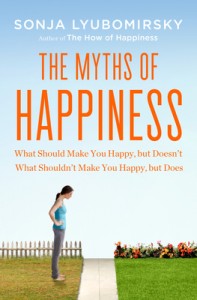
In her book The Myths of Happiness, Sonja Lyubomirsky calls them crisis points.
They’re the kind of events that leave you feeling like things will never be the same. And love them or hate them, they happen to everyone.
These crisis points can be times of renewal and growth, but let’s keep it real – we rarely seem to view them as such when we’re going through them.
Therein lies the key – how do you deal with them.
Myths is about identifying the steps that will work for you, and as in any area of life, there is no one-size-fits-all solution.
I recently asked,
If happiness is a choice, why don’t we always choose it?
I wasn’t surprised to find that most people believe it is a choice, but the question remains,
Why don’t we always choose it?
That’s the question I had in mind as I began reading the book.
Back to those crisis points, what we’d consider major turning points in adult life. Some (marriage, children, professional satisfaction and wealth) are considered more positive than others (being single, divorce, financial issues, and illness) but they all have their challenges.
Lyubormisky argues that we’ve been given false promises, myths that lead us to thinking lifelong happiness will be met when we hit these culturally confirmed markers of adult success.
Consider the following:
The woman who is successful in ways the rest of us would consider amazing, but she isn’t happy because at 45 she’s still single and childless.
Or how about the young couple who have a great life, love their work and lifestyle, but can’t be happy because they’ll never be able to afford a house in their city of choice.
Examples of the “I’ll be happy when…” syndrome.
You can’t win in any scenario that follows this formula.
This reliance on the external circumstances can wreak havoc on your happiness, and longterm well-being.
It’s a restricted view that keeps us from growing when life throws us a curveball. And if we can’t learn from it, we can’t move past it and so, the vicious cycle begins.
Mindset Matters More Than Circumstances
Lyubormirsky asks us to look beyond our first response to an event, to look deeper into our mindset instead of our circumstances. She invites us to begin the practice of making wiser choices in life. And it is an ongoing practice.
“When we practice optimism, we become more confident, more motivated, and more energetically engaged with our goals, we take more proactive steps toward achieving them, and we are more committed, persistent, and task focused.” – S.L.
The book is broken down into three main sections:
- Connections (relationships)
- Work and money
- Looking back (your past and future)
For each area, she gives practical advice based in research, but with a personal perspective that constantly reminds us of our humanity.
We all go through this.
The main crisis point in my own life knocked me out at 30. My first longterm relationship ended suddenly, without warning, and life as I knew it was gone in an instance. Grief beyond anything I’d ever experienced turned into depression, and the days turned into months. I had no idea how to deal with it, and I thought I’d never be happy again.
Independant and strong, I thought I could deal with it alone, which led to my greatest breakthrough and learning.
It was the worst time of my life but it also put on the path of personal growth, and ultimately, becoming a coach and writer – an outcome I’d never have predicted given how my life was going before this crisis point.
Lyubomirsky reminds us to live life in the flow of have-do-be, which is the opposite of what we mostly see if we look around. Myths offers its greatest gift in reminding us that nothing in life outside of you can make you happy in and of itself.
You might be able to fool yourself for a while, but it will catch up with you. That knowledge opens the door to making better choices in life.
The good news is that practicing the recommendations in this book can help us get through the crisis points with more grace and ease, transforming them into rich life experiences.
I think when you’re going through a really challenging time, there’s a point where you realise that you’re still waking up every day, getting on with things (even if you’re functioning at a much lower level than usual) and that this in itself is a symbol of your strength and courage. I remember having this epiphany and suddenly feeling a lot more confident in my ability to cope. When things have been tough, I’ve found myself recognising and appreciating the small pleasures in life a lot more.
On a side note, I recommend the Live Happy app, which was co-created by Sonja. It’s a great tool for developing conscious thoughts and behaviours around gratitude. Here’s the link: http://www.signalpatterns.com/iphone/livehappy_std.html
Hannah BWYA Yes, I agree! I remember during that dark time in my life, noticing beauty around me as I was out on a walk and thinking, if I can still notice beauty things are not so bad. And that thought then made me feel more confident about my ability to get through it. Noticing our resilience is a huge confidence booster!
Thanks for the app tip!
Hannah BWYA Yes, I agree! I remember during that dark time in my life, noticing beauty around me as I was out on a walk and thinking, if I can still notice beauty things are not so bad. And that thought then made me feel more confident about my ability to get through it. Noticing our resilience is a huge confidence booster!
Thanks for the app tip!
Challenging times can make someone strong, but you can also fall into depression and feel that your life will never be the same. When I discovered my child was dependent on drugs, I went through a long phase of feeling unhappy and that I would not be happy again until it was all over, but the truth is that these kinds of things are never over. They may be managed, but they are life long. I learned to be happy for today. That is all we have. Thanks for an interesting review. I will check out the book.
Cathy Taughinbaugh When I first felt the depression I mentioned in the post I was actually limited by my belief that I was strong and could get through it on my own. It took me 3 months to get the professional help I needed – and I still resisted. I’m still not great at asking for support; it’s an ongoing challenge for me, but it helps to realize we all need help now and then.
And happy for today is as good as it gets. Plus it’s kind of a relief to keep the focus on today, isn’t it?
Sandi,
I thoroughly enjoyed reading this post. Having gone through yet another major turning point in my life I can totally relate.
The main thing that stood out for me was to continually remember to: Be, Do, Have.
I spent at least 2 decades struggling to Do, Have, Be and burned out in a big way. I may take two steps forward and one big one back once in a while but, I never want to run my life down to empty again chasing the “have” part. The payoff of “having” is so not worth the monumental effort when it’s done in this manner.
I’m finally learning to be kinder to myself and to give myself what I want rather than what I “think I should want.”
Thank you for making me take the time to pause and think dear friend.
xoxo,
Angela
AngelaArtemis I’m still amazed at the magnetic pull to Do.Have.Be. It’s almost automatic for most of us, isn’t it? I remind myself of what works – Be.Do.Have. – by being with nature, getting silent, going on retreat, etc. Those practices always return me to a more empowered place.
And I agree, what I ‘should want’ is rarely what I need or what would make a difference in my life! Think that should be a tattoo…or maybe a poster 😉
Hi Sandi,
I have no valid insights into Happiness/ what makes you happy other than it’s a personal thing. Certainly what you have written here makes a deal of sense to me. “Being Happy when” is totally worn out. It’s difficult to chase that elusive (it seems) happiness. Re constructing what you see as ‘happiness’ and stop chasing but enjoying what you have at the moment makes better sense to me. Thankyou for this.
Be good to yourself
David
David Stevens Absolutely agree! The pursuit of happiness is a slippery slope that I’ve tumbled down too many times. Noticing, choosing, inviting happiness is much more fulfilling than pursuing 🙂
My crisis point was when I was laid off from my job. It shook many of my beliefs about work, yet I made the most of it. We had enough saved up to get by for a few months, so I spent a lot of time with my family enjoying the time away from work. It ended up being the best three months of my life. I got to spend that time with my young daughter. We spent entire days together doing things that were low cost or free.
ericwest What an awesome reframe Erick! And what a brilliant experience for you and your daughter. Thank you for sharing it.
Another great happiness post Sandi. Like all the most wonderful things in life, it’s definitely an inside job and one that’s uniquely ours to experience in ways that matter to us. I like what David has to say about enjoying this moment too.
Love Elle
xoxo
ElleSommer Definitely an inside job! Love that we’re in it together 🙂
ElleSommer Definitely an inside job! Love that we’re in it together 🙂
I was just thinking about happiness last night. Right now I’m going through what I would definitely call a crisis point in my life plus this week I received very disturbing news about the health of a family member plus we’ve got a huge winter storm coming in tonight plus I’m quite worried about one of my best friends plus, plus, plus! In other words, life is challenging. When is it not, right?
But last night, as I bent down to pat one of my cats and have a conversation with her (yes, I am that weird cat lady I was always afraid I’d turn into!), I realized something. I was happy. Not “just” content or satisfied but actually happy. This morning I woke up at an ungodly hour and realized, yep, I’m still happy. I think I never realized before that happy can exist in the same place as fear, worry, sadness, etc. Perhaps it’s a question of becoming aware of the happy, acknowledging, and celebrating it.
Carol Hess yes, Yes, YES!!! Becoming aware, acknowledging, celebrating…all work way more than pursuing and chasing happiness. Nothing like the pursuit of happiness to kill it off completely!
I’ve always been of the opinion that mindset matters much more than circumstances – sounds like Sonja and I are on the same page there!
Thanks for being a part of this tour.
heathertlc That’s a smart page to be on 😉
heathertlc That’s a smart page to be on 😉
I sure am. If you “choose to be happy”, you can be happy no matter what (unless you suffer from a mental illness that prevents you from feeling that way). I’ve known cancer patients who were the happiest people ever because they “chose to” and they dealt with their fate in amazing ways. I’ve certainly dealt with my share of self-pity, but whenever I step back and decide to change the way I look at my situation, miraculous things start to happen and everything feels “easier” and simpler. Let’s face it, life sucks at times and it does so for everyone, but we can always choose to smile, can’t we?
anneso87 I totally agree; it’s not always an easy choice but it is a choice (excepting mental illness, as you’ve said) and often we don’t want to be responsible for that choice. I love your suggestion in a recent post about having a pity party but inviting your friends over! I think as we bring humour and play to our crisis points the more we can move through them with ease.
Sandi Amorim agreed!