The inner critic, gremlin, nasty voice in your head – whatever you call it, you’ve got one.
Here’s mine.
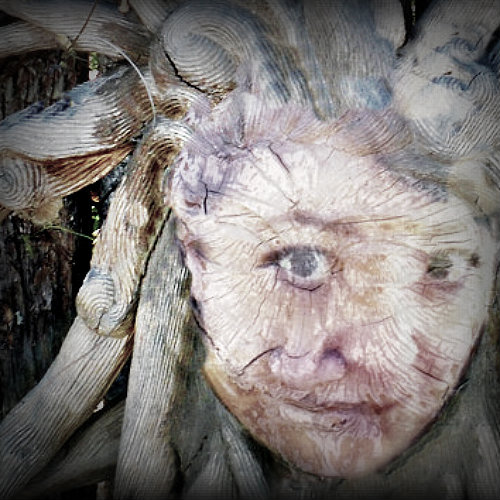
She’s harmless enough until something I’ve done (or not done) gets her attention and suddenly…
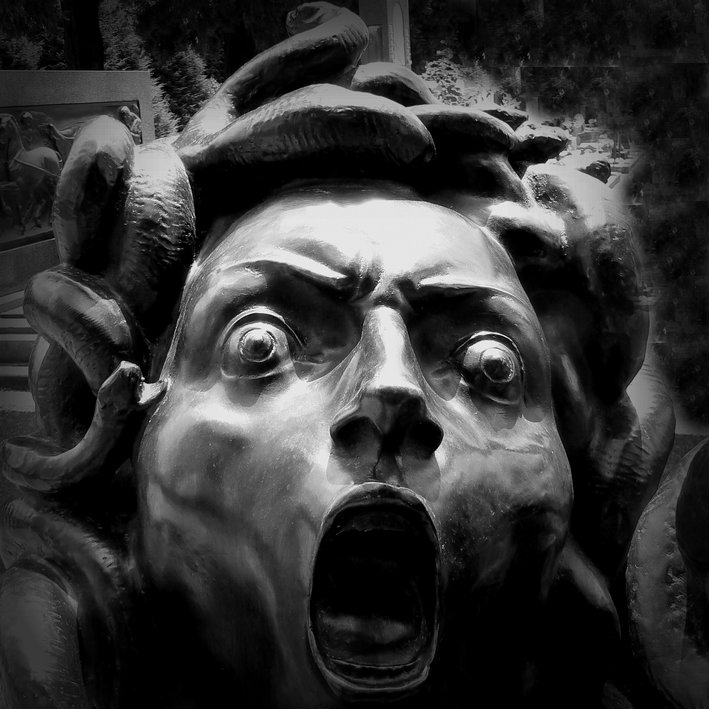
She unleashes a torrent of judgment and furious opinion that leaves me reeling, some days weeping.
She’s me, not me. A tangle of stories and limiting beliefs accumulated over a lifetime.
She lurks, waiting for just the right moment to pull the rug out from under me triggering feelings of lack, disappointment, and doubt.
Her name is Medusa, and like her namesake who struck fear into the hearts of men, one stinging comment or look from her and I am immobilized.
And yet, I do my best to befriend her, to quiet her strident, demanding voice.
Some days this feels like an exercise in futility; other days I get through to her and the result is always worth the effort.
For Medusa (naming your inner critic is powerful) is not the enemy despite the frenzy she stirs up.
She exists for your survival (one more aspect of your lizard brain), ensuring you stay out of trouble, and she has one overriding goal – to keep you safe.
Everything else, including how you feel, is secondary to that goal.
She shows up, uninvited like an over-zealous friend trying to get her point across without regard for your feelings. You know someone like this; their intentions are good, if somewhat clouded by their questionable tactics.
[Tweet “Your access to freedom is developing a relationship with your inner critic.”]
One that serves a purpose, freeing you up from the spin of Medusa’s crazed, wild-eyed accusations.
Disarming Your Inner Critic
1. Challenge
Medusa is up for a debate any time, so stand up and challenge her! Question her logic. Interrupt her ranting, and disrupt her flow. If you wait for an opening you could wait a very long time as she is relentless.
Do what you have to do to stop the tirade.
What would happen if you stopped listening to your inner critic so intently and started questioning, challenging its authority?
2. Negotiate
It is possible to negotiate with the critic – it just takes time. Remember the critic’s job is to keep you safe. So instead of announcing a big, hairy, audacious goal to the entire world, share it wisely. A friend, a supporter, a coach – ask a trusted source for feedback before going public.
Here’s what that might look like:
Me: I’ve just had the best idea for a new project!
Medusa: Are you crazy? You don’t have time for anything else. When will you learn? And by the way, who the hell do you think you are?
Me: I know, I know, but just the thought of this project makes my heart race with excitement!
Medusa: Look, we’ve been here before and it didn’t work out. Remember what happened last time?
Me: I know, I know. I didn’t write the book like I said I would, but I’ve worked on it! How about if I promise to tell just one friend? She can help me stay on track and give me some feedback along the way.
Medusa: Fine. One friend, but make sure she doesn’t announce anything on Facebook. I’ll be watching.
Negotiate the terms, then get to work. Medusa’s got your back.
3. Imagine
The stuff your inner critic comes up with isn’t true. It’s mostly made up of your fears, and the limiting beliefs of a lifetime.
It’s all made up. So why not make up something good? Something that totally taps into how you want to feel!
Close your eyes, take a deep breath and imagine something you really want. See yourself in your mind’s eye with the desired outcome. Your imagination will fill in the details: What do you see, hear and feel? Pay particular attention to how it feels in your body. Your body doesn’t lie. Trust it.
Shift your attention from Medusa’s internal chatter to your visual brain. With practice, this exercise can become your most powerful ally.
“Every time a self-critical thought comes to mind, I will forgive the Judge and follow this comment with words of praise, self-acceptance, and love.” – Don Miguel Ruiz
4. Appreciate
If the critic is there for your safety and survival, that’s something to appreciate. I noticed that Medusa stays pretty quiet when I acknowledge all the awesome in my life.
Right now, in this moment look around, what do you appreciate?
5. Accept
Medusa isn’t going anywhere. When you accept your inner critic, you’ll feel a dramatic decrease in frustration. When you shift from beating yourself up to acceptance and even curiousity, you’ll be able to get her message without the prolonged suffering.
Relax, pull up a comfy chair and settle in for a conversation rather than a battle, and remember she’s truly on your side.
My inner critic is named Cassandra. She’s beautiful and smart and amazingly cruel. She’s ALWAYS beating me up, but slowly, over time, I shall befriend her. 🙂
syddiegrl I remember Cassandra 😉
And yes, like Medusa, she will eventually succumb! Until then, stay out of her way and keep doing good work!
syddiegrl I remember Cassandra 😉
And yes, like Medusa, she will eventually succumb! Until then, stay out of her way and keep doing good work!
Ooo, I’m working on this one today…but I believe she is one in the same with my ego/devil on the shoulder, lovingly named Shanaynay!
Shanaynay is all about getting up in other people’s business, comparing what I’m doing and not doing, and then sitting there fussing about all the wrong things (such as how my hair looks or how I need to get up and move my butt). She’s queen of “THE look” – the “you did WHAT?” look, that is. Very feisty – loves hip hop (old school) – and totally trying to keep me from embarrassing myself (“looking the fool” as she puts it).
I love to remind her that her ghetto-fabulous self makes a good point or two (and a whole lotta bad points), and that she needs to hush up so I can get something done in life that’s worth something. She usually listens – or gets quiet long enough for me to do it anyway!
Sabrina at MyMiBoSo Shanaynay and Medusa should go out partying together 😉
@Sandi Amorim Right? That’s totally one of the ways I deal with her by the way…a glass of wine and a sense of humor does wonders for turning down Shanaynay’s intensity.
Sandi, This complete strikes the heart of the matter! My Medusa, for one thing, compares. “How could you ever be as creative as so and so.” She tells me I’ll never get there and more. I love the idea that freedom comes from establishing a relationship with our inner critic! It’s time to try that on.
Sandra Pawula I think comparison is one of our inner critic’s biggest tools because she always decides we aren’t good enough. Always (which just goes to show how wrong she is!).
Carol Hess Sandra Pawula The critic is wrong a lot of the time but her driving purpose – keeping you safe – will not allow her to see anything else. It’s like she has tunnel vision!
Sandra Pawula Oh yes, I think comparison is the inner critic’s favourite tool. I came up with a statement I tell myself whenever Medusa goes there with me. I say, “You’re right, so and so is a little further ahead on the path. I’m right behind her.” Somehow reminding myself that we’re all walking the path helps ease the angst!
Sandra Pawula Oh yes, I think comparison is the inner critic’s favourite tool. I came up with a statement I tell myself whenever Medusa goes there with me. I say, “You’re right, so and so is a little further ahead on the path. I’m right behind her.” Somehow reminding myself that we’re all walking the path helps ease the angst!
You and I are speaking the same language. Someone (Tess Marshall) tweeted your link so I had to check it out. I love this. I love the idea of NAMING my inner critic and of having a civil discussion with her on a range of issues she seems to be concerned about. Great stuff!
amyputkonen Name it, describe it, and even have some fun with it! I’ve written out conversations with Medusa, I’ve collaged images of her, and shared her with others. Even when I’m in the midst of a full blown Medusa attack I can still find the humour now because I see her so clearly.
Great to ‘meet’ you Amy and happy we speak the same language! 🙂
Wow! How did you create that first image? It blew me away! My inner critic, Dragon, goes to such ridiculous lengths to keep me in my place where she feels safe that a lot of the time I have to just plain laugh at her. That’s when she breathes fire and smoke big time! (She doesn’t like to be laughed at.) But occasionally she sees how ridiculous she’s being and snorts — thereby scorching her throat and choking herself on her own fire and smoke. Silly Dragon.
Carol Hess I had so much fun with that first image. A photo I took of a gnarly old tree with my face superimposed on it and voila…Medusa! Well, Medusa in her calmer moments. As you can see from the second photo, when she is triggered it ain’t pretty!
Love that your critic is a dragon! Is there anything scarier than a fire breathing dragon in children’s stories? And usually, the dragon is protecting someone or something. it’s perfect!
LOve this – especially the images – good to make them concrete! Thae can get a hanle on these inner objects?
Petah
LOve this – especially the images – good to make them concrete! Thae can get a hanle on these inner objects?
Petah
PetahDigby Yes, getting the visual is usually so helpful! Took me awhile to get clear, but once I did it became a great inner GPS!
Oh, I was just now able to finally come read this. Soooooo wise and real and true. I can tell this is some HARD-WON wisdom, Sandi. And these images are phenomenal!
I’ve tried many times to name/visualize my inner critic, and I usually just get nuthin’. I can evoke the FEELING very well, but just don’t get a visual that sticks, at least not of any kind of person or animal. The closest I can come is a whirling dark cloud — like the Tasmanian Devil of Anxiety and Fear, or the moving ball of dust and yuck that surrounds Pigpen wherever he goes. But instead of dust and yuck, it’s shame and criticism.
Hmm. That one feels more real than anything I’ve ever come up with before….thanks!
LynnHess Getting the feeling is just as important! It took me a long time to get the visual of Medusa, but I knew damn well what she felt like. Seems like your inner critic is very kinaesthetic. Hang out with that for awhile and notice what comes through!